
Lectures · Live Music · Instrument Demonstrations
Bring Salsa History to Life
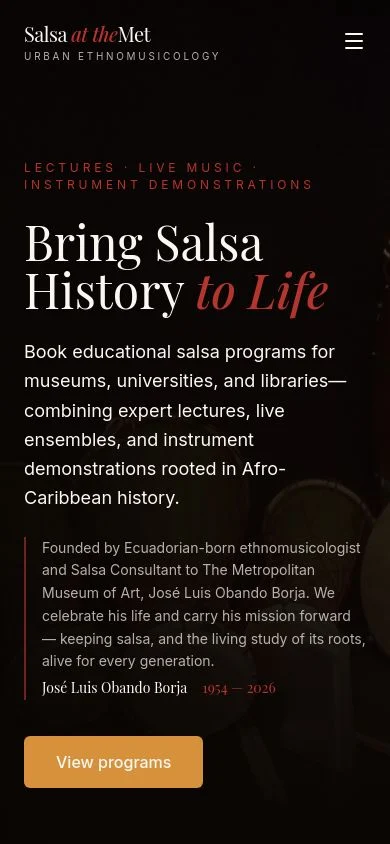
Book educational salsa programs for museums, universities, and libraries—combining expert lectures, live ensembles, and instrument demonstrations rooted in Afro-Caribbean history.
Founded by Ecuadorian-born ethnomusicologist and Salsa Consultant to The Metropolitan Museum of Art, José Luis Obando Borja. We celebrate his life and carry his mission forward — keeping salsa, and the living study of its roots, alive for every generation. José Luis Obando Borja 1954 — 2026
Salsa at the Met, on your phone
Install the app on Android or iPhone for one-tap access to his programs, archive, and video library.
No app store needed. Pages you've opened stay readable offline.
A life in salsa
From Guayaquil to the great halls of New York, José Luis Obando Borja spent his life making the case that salsa is history you can hear — an American genre born of African, Taíno and Spanish roots, worthy of the world’s finest museums.
“Salsa is music that makes people smile. I am not an entertainer — I am an educator.”
- 1954
Born in Guayaquil
José Luis Obando Borja is born in Guayaquil, Ecuador, where his lifelong love of Latin American music and culture first took root.
- 1963
A new home in New York
He makes his life in New York City, immersing himself in the Afro-Caribbean musical traditions of El Barrio and Spanish Harlem.
- 2001
Salsa Consultant to the Met
He becomes Salsa Consultant to the Department of Musical Instruments at The Metropolitan Museum of Art — the nation's only museologist dedicated to salsa.
- Legacy
A mission that continues
Through the Salsa Museum and decades of lecture-demonstrations, he devoted his life to preserving Latin American cultural heritage through music and education.
A monthly letter to keep his work alive.
Receive new archive discoveries, performances, and community stories celebrating José Luis Obando Borja and the cultural history he worked to preserve.
Salsa in a sacred space
For years José carried his lecture-concerts to one of New York’s grandest stages — the Cathedral of St. Patrick — making the case, as he always did, that this music belongs among the world’s great halls.


The Met’s salsa collection
The Metropolitan Museum of Art has been collecting musical instruments since 1880. Its acquisitions of Afro-Native-Antillean instruments that pertain to salsa each arrive with a documentary that outlines the origins of the artifact — drawing on the social sciences and the humanities, and an autobiography of the artisan.
The raw materials, tools and manufacture of these artifacts, through the recording, preserve the artisan’s expertise and the vibrancy of the ethnographic record.
- 1880
- Collecting instruments since
- 2001
- Salsa Consultant to the Met since
- 350+
- Years of salsa's evolution

A letter from The Met
In 2016, J. Kenneth Moore — the Frederick P. Rose Curator in Charge of the Department of Musical Instruments — wrote in support of José after sixteen years of collaboration with the Museum.
“He worked with diverse makers, documentarians and consulates to help with the acquisition of seven instruments and three documentaries… These films are invaluable historic documents.”Read the full letter
Interdisciplinary museum programs
The lecture-demonstrations José created illustrate the roughly 340–350 year evolution of the American musical genre, salsa. Grounded in Urban Ethnomusicology and augmented by a live ensemble, they were presented at every educational level — from lower school to post-graduate faculty development. Carrying this work forward is how his mission lives on.
- 01Geography
- 02History
- 03Theology
- 04Political Science
- 05Linguistics
- 06Archeology
- 07Anthropology
- 08Sociology
- 09Art History
- 10Music History
- 11Dance History

Musicians who carry the tradition
The lectures are augmented by musicians who are conservatory-, folkloric- and street-trained. Many are Grammy-award winners and nominees, bringing the living sound of the genre into the museum hall.
Some percussionists and dancers are high-ranking clerics, or are trained within the Afro-Caribbean syncretisms — Santería / Lucumí, Palo Monte, and Abakuá — that shaped salsa’s ceremonial roots.
Where he taught, since 1998
Over the years, José brought these lecture-demonstrations to museums, universities, libraries and cultural institutions across the country.
- ·The Metropolitan Museum of Art
- ·El Museo del Barrio
- ·Queens Museum of Art
- ·Studio Museum in Harlem
- ·The Cathedral of Saint Patrick
- ·The Juilliard School
- ·New York Public Library
- ·The Apollo Theater
- ·The U.S. Naval Academy
- ·Harvard University
- ·Horace Mann School
- ·Grace Church School
- ·Riverdale School
- ·The Cambridge School of Weston
Watch & remember
José in his element — teaching the history of salsa through the instruments he loved. A growing archive of his lectures and performances, kept alive for every generation.
Share a memory of José
A lecture that stayed with you, a performance you’ll never forget, or a few words of gratitude — your memories help us celebrate his life and carry his mission forward. We’d love to hear from you.